Metal Staircase Fabrication and Installation Guide
Metal staircases represent a critical component in modern commercial and residential building infrastructure, offering durability, code compliance, and design flexibility that traditional materials often cannot match. Whether you're managing a condominium association facing milestone recertification requirements or overseeing a commercial property renovation, understanding the intricacies of metal staircase fabrication and installation ensures your building meets safety standards while maintaining structural integrity for decades to come.
Understanding Metal Staircase Systems and Their Applications
Metal staircases serve diverse purposes across South Florida's building landscape. From emergency egress routes in high-rise condominiums to decorative interior features in boutique hotels, these systems must balance aesthetic appeal with rigorous safety requirements.
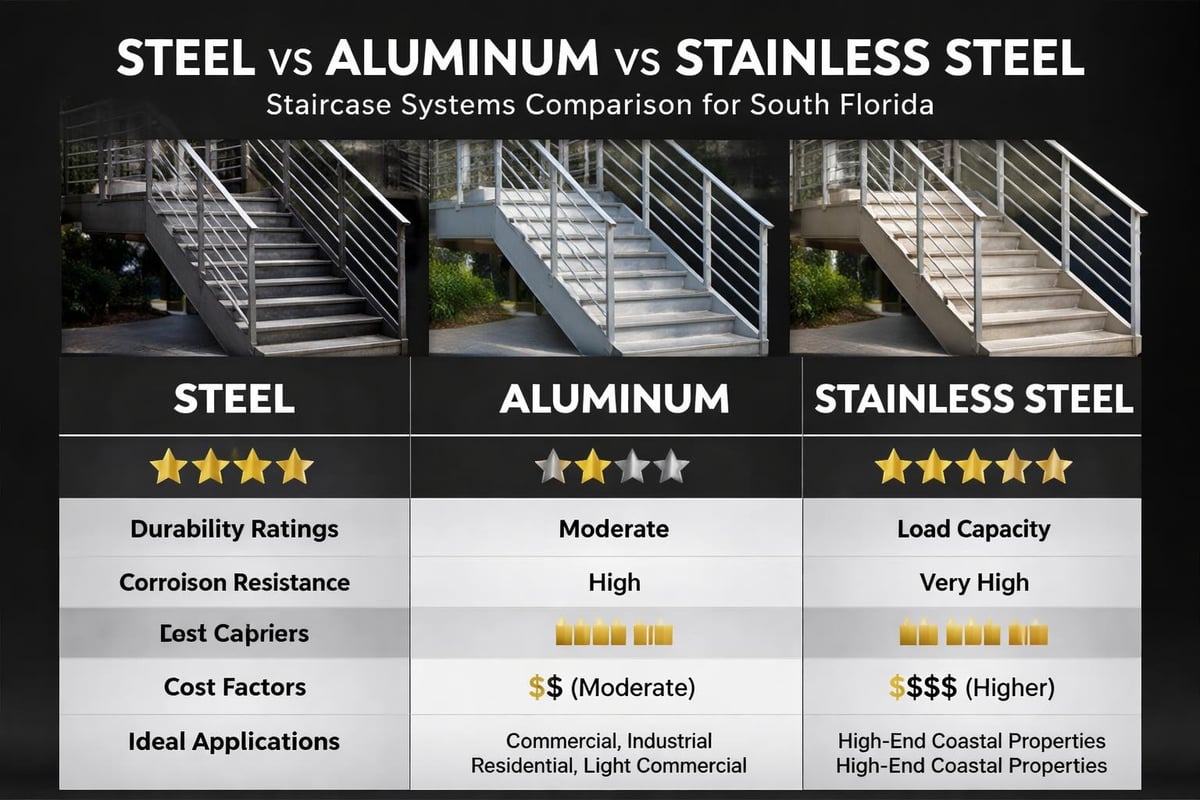
The primary materials used in metal staircase fabrication and installation include steel, aluminum, and stainless steel. Each material offers distinct advantages depending on the application and environment.
Steel staircases provide exceptional strength-to-weight ratios and cost-effectiveness, making them ideal for high-traffic commercial applications. Aluminum systems excel in coastal environments where corrosion resistance is paramount, a critical consideration for South Florida properties exposed to salt air. Stainless steel options combine durability with premium aesthetics, often selected for visible installations in luxury residential buildings.
Common Applications for Metal Stair Systems
Property owners and managers typically encounter metal staircase needs in several scenarios:
- Replacement of deteriorating concrete stairs during milestone building inspections
- Emergency egress compliance upgrades
- Accessibility improvements requiring code-compliant ramps and landings
- Balcony and terrace access systems
- Interior feature stairs in lobby renovations
- Fire escape replacements during building recertification
Understanding when metal systems provide the optimal solution requires evaluating structural conditions, environmental factors, and long-term maintenance considerations. For properties undergoing 40-year building recertification, metal stair replacement often addresses multiple violation categories simultaneously.
Code Requirements and Engineering Standards
Metal staircase fabrication and installation must comply with multiple code frameworks that govern dimensional requirements, structural capacity, and safety features. The International Building Code (IBC) establishes baseline requirements, while Florida Building Code incorporates additional provisions specific to regional concerns including hurricane resistance and corrosion protection.
Building codes and regulations dictate critical dimensional parameters that directly impact fabrication specifications. Understanding these requirements before fabrication begins prevents costly modifications during installation.
| Code Parameter | Typical Requirement | Notes |
|---|---|---|
| Tread Depth | Minimum 11 inches | Measured horizontally between nosings |
| Riser Height | Maximum 7 inches | Must be uniform throughout flight |
| Stair Width | Minimum 44 inches | For occupant loads over 50 |
| Headroom | Minimum 80 inches | Measured vertically from tread nosing |
| Landing Depth | Minimum 48 inches | In direction of travel |
Structural Engineering Considerations
Proper metal staircase fabrication and installation requires detailed structural engineering design analysis to ensure adequate load capacity. Commercial stairs must typically support live loads of 100 pounds per square foot, while assembly stairs require 100 pounds per square foot or greater.
Connection details represent critical engineering elements. Stair stringers must transfer loads effectively to supporting structures through properly designed moment connections or bearing plates. In existing buildings, engineers must evaluate whether existing structural members can accommodate new stair loads or require reinforcement.
Handrail and guardrail systems integrate structurally with the stair assembly while meeting specific code requirements. Guardrails must resist 200 pounds applied in any direction at any point along the top rail. Handrails must support 200 pounds in any direction and maintain continuous graspability with specific dimensional requirements.
The step-by-step engineering process includes load calculations, member sizing, connection design, deflection analysis, and vibration assessment to ensure occupant comfort.
Material Selection and Fabrication Processes
Selecting appropriate materials for metal staircase fabrication and installation depends on environmental exposure, aesthetic requirements, budget constraints, and maintenance capabilities. South Florida's coastal climate demands particular attention to corrosion resistance.
Material Options and Specifications
Carbon steel offers the most economical solution and widest fabrication flexibility. Stringers are typically fabricated from channel sections (C12x20.7 or similar) or built-up plate sections. Treads may be solid plate, bar grating, or pan-filled designs. When properly protected with high-performance coating systems, carbon steel provides decades of service.
Aluminum alloys (typically 6061-T6 or 6063-T6) eliminate corrosion concerns entirely while reducing weight by approximately 65% compared to steel. This weight reduction simplifies installation logistics and reduces loads on supporting structures-a significant advantage in retrofit applications. The material naturally forms a protective oxide layer and requires minimal maintenance beyond periodic cleaning.
For custom metal stair systems requiring premium aesthetics and maximum corrosion resistance, stainless steel grades (304 or 316) provide unmatched longevity. Grade 316 offers superior chloride resistance, making it ideal for properties within direct salt spray zones.
Fabrication Shop Operations
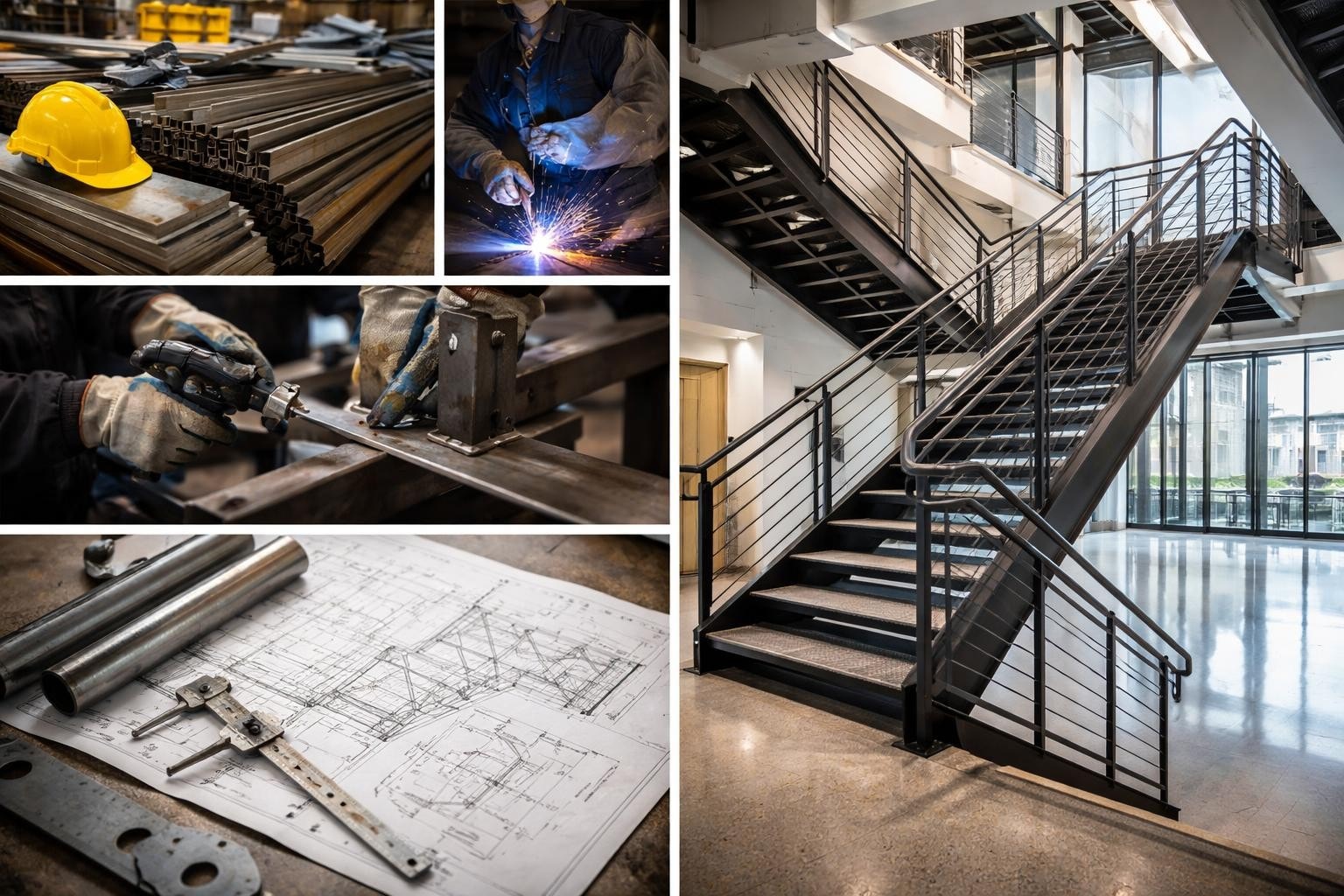
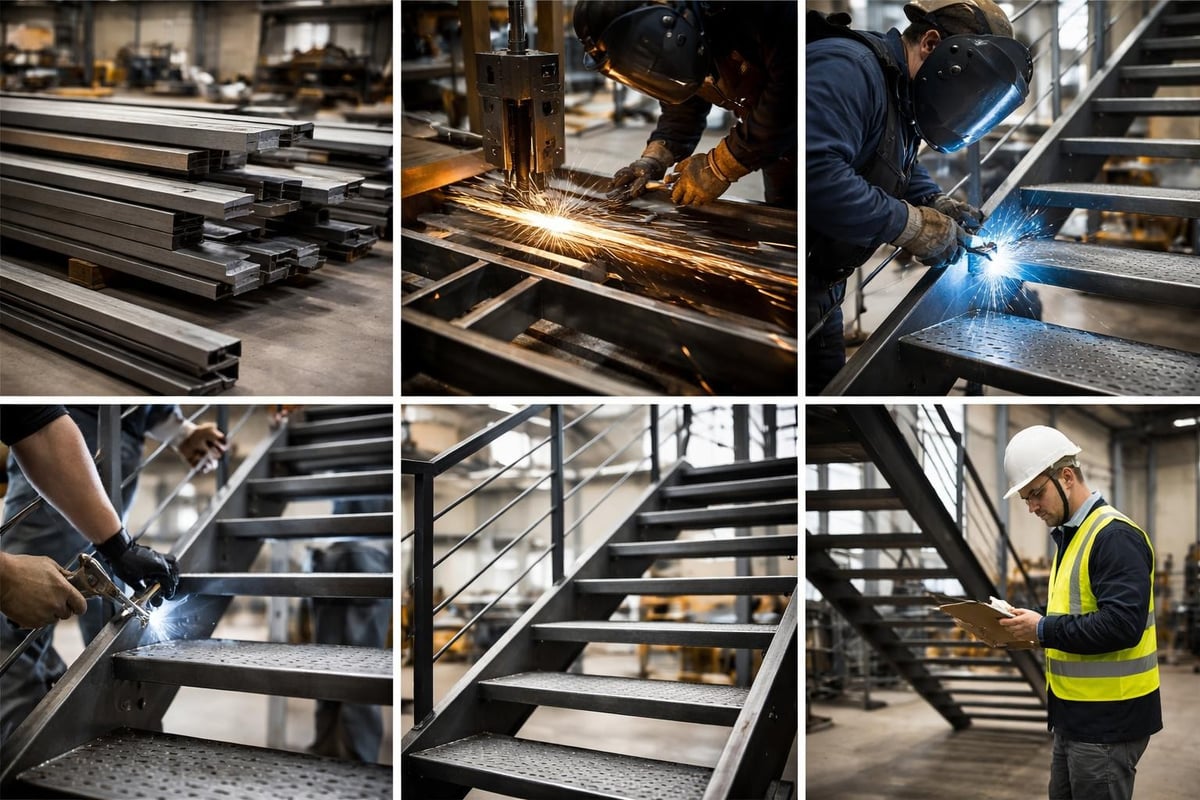
Professional metal staircase fabrication follows systematic processes that ensure dimensional accuracy and structural integrity. Understanding metal stair fabrication techniques helps property managers evaluate contractor capabilities.
- Engineering review and shop drawing preparation - Fabricators translate architectural designs into detailed shop drawings specifying every dimension, connection, and material specification
- Material procurement and inspection - Raw materials must meet ASTM specifications with proper mill certifications documenting chemical composition and mechanical properties
- Precision cutting and forming - CNC plasma tables, water jets, or laser cutters ensure accurate cuts while minimizing heat-affected zones
- Welding and assembly - Certified welders execute connections per AWS D1.1 specifications, with proper sequencing to minimize distortion
- Surface preparation and coating - Abrasive blasting removes mill scale and contaminants before application of protective coatings
- Quality control inspection - Dimensional verification, weld inspection, and coating thickness measurement ensure specification compliance
Tread design options significantly impact both fabrication complexity and installed performance:
- Bar grating treads provide slip resistance and drainage, ideal for exterior applications
- Pan treads with concrete or terrazzo fill offer smooth walking surfaces for interior installations
- Checkered plate treads combine slip resistance with solid surfaces
- Perforated metal treads balance drainage with solid footing
Installation Planning and Execution
Successful metal staircase fabrication and installation requires meticulous planning that begins long before the first component arrives on site. Coordination with other trades, precise sequencing, and thorough safety protocols ensure efficient installation without compromising quality.
Pre-Installation Site Assessment
Field verification of existing conditions prevents costly surprises during installation. Even when working from precise construction documents, buildings shift, concrete spalls, and actual conditions vary from drawings.
Critical verification measurements include:
- Exact floor-to-floor heights at stair locations
- Plumb and level conditions of supporting walls
- Actual locations of structural members where stair connections occur
- Clearances for rigging and component delivery
- Accessibility for welding equipment and power sources
- Temporary shoring requirements if existing stairs must remain operational during replacement
For properties undergoing concrete restoration and structural repairs, metal stair installation may need to coordinate with concrete repair schedules to ensure connection points meet specified strengths before load transfer.
Installation Methodology and Safety Protocols
Professional installation teams follow systematic procedures that prioritize both worker safety and installation quality. Standards for metal stairs emphasize quality control throughout the installation process.
Rigging and positioning demand careful planning, particularly for multi-flight assemblies or installations in occupied buildings. Crane access, weight distribution, and fall protection systems must be established before any lifting operations commence.
Connection execution varies by structural conditions and engineering specifications:
| Connection Type | Application | Installation Considerations |
|---|---|---|
| Welded connections | Steel-to-steel attachments | Requires hot work permits, fire watch, qualified welders |
| Bolted connections | Adjustable installations | Allows field adjustment, requires proper torque procedures |
| Embedded plate anchors | New construction | Must coordinate with concrete placement |
| Post-installed anchors | Retrofit applications | Requires core drilling, proper embedment depth |
Alignment and leveling require patience and precision. Stringers must align within specified tolerances (typically ±1/8 inch) to ensure uniform riser and tread dimensions. Handrail systems must flow continuously without abrupt direction changes that could snag clothing or cause hand injuries.
Quality Assurance and Code Compliance Verification
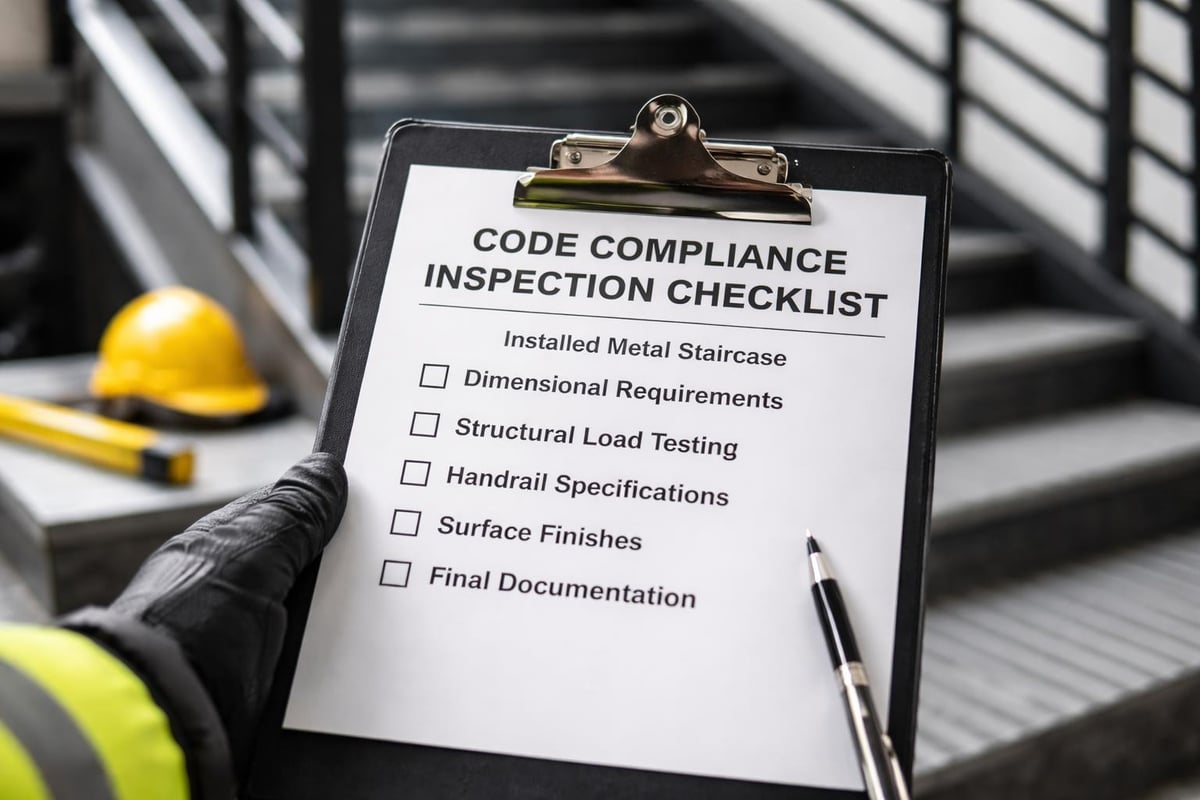
Metal staircase fabrication and installation concludes with comprehensive inspections verifying code compliance and installation quality. This phase protects property owners from liability while ensuring long-term performance.
Inspection Protocols and Documentation
Dimensional verification confirms that installed stairs meet all code requirements for rise, run, width, and headroom. Even minor deviations can trigger code violations during building department inspections or building recertification reviews.
Structural testing may include load tests for critical installations or high-occupancy applications. Non-destructive testing methods verify weld quality without damaging completed assemblies.
Guardrail and handrail testing ensures these life-safety systems meet structural requirements. Load tests apply specified forces to verify adequate resistance without permanent deformation.
Proper documentation includes:
- Shop drawing approvals with engineer's stamp
- Material certifications (mill test reports)
- Welding certifications and weld maps
- Coating thickness reports
- As-built dimensions
- Photographic documentation of installation progress
- Building department inspection approvals
For condominium associations and commercial property managers, this documentation becomes essential during future property transactions, insurance reviews, or subsequent building modifications.
Maintenance and Long-Term Performance
While metal staircases require significantly less maintenance than concrete or wood alternatives, systematic inspection and preventive maintenance optimize service life and preserve aesthetic appeal. For South Florida properties, attention to corrosion protection is particularly important.
Routine Inspection Programs
Property managers should incorporate metal stair systems into quarterly building inspections. Visual assessments identify coating degradation, connection loosening, or unauthorized modifications before minor issues escalate into safety hazards.
Specific inspection points include:
- Coating condition on treads, stringers, and railings
- Tightness of bolted connections
- Weld integrity around high-stress connections
- Tread attachment security
- Drainage functionality (for exterior stairs)
- Guardrail firmness and height maintenance
Annual professional assessments by qualified engineers provide deeper analysis, particularly for stairs in corrosive environments or high-traffic applications. These inspections should document any deterioration and recommend corrective actions before conditions affect safety or code compliance.
Protective Coating Maintenance
Coating systems represent the primary defense against corrosion, making their maintenance critical for long-term performance. South Florida's climate accelerates coating degradation through UV exposure, salt spray, and thermal cycling.
Coating inspection should note any areas where primer or topcoat has failed. Common failure modes include chalking (surface degradation), checking (fine cracks), and delamination (coating separation from substrate). Early intervention through spot repair prevents accelerated corrosion.
Recoating schedules depend on initial coating quality and environmental severity. Properly applied high-performance coating systems typically provide 10-15 years of service before requiring comprehensive recoating. Areas subject to foot traffic, hand contact, or direct weather exposure may require more frequent attention.
For aluminum stairs, maintenance focuses on cleaning and inspection rather than coating renewal. Periodic washing with mild detergent removes accumulated contaminants that could stain the oxide layer or trap moisture against adjoining materials.
Addressing Common Issues
Connection loosening occurs naturally as buildings experience thermal movement and vibration. Quarterly inspection and retorque of accessible bolted connections prevent progressive loosening that could lead to structural issues.
Drainage problems on exterior stairs cause accelerated deterioration. Ensure weep holes remain clear, and verify that stair slopes direct water away from building connections. Standing water accelerates corrosion even in treated steel and can cause freeze-thaw damage in locations experiencing occasional freezing.
Modifications and alterations by building occupants pose significant liability risks. Unauthorized attachments, removed components, or structural modifications can compromise engineered load paths. Property managers should establish clear policies prohibiting unauthorized stair modifications and enforce these through lease provisions and tenant education.
Integration with Building Systems and Renovations
Metal staircase fabrication and installation rarely occurs in isolation. These systems interface with numerous building components, requiring careful coordination during design and installation phases.
Electrical integration for lighting represents a common coordination requirement. Stair lighting enhances safety while meeting code requirements for egress illumination. Electrical system upgrades may be necessary to support new lighting loads or emergency power requirements.
Waterproofing coordination is critical for stairs penetrating building envelopes or connecting to balconies. Improperly detailed connections create water intrusion paths that damage interior finishes and accelerate structural deterioration. Coordination with water intrusion investigation specialists ensures comprehensive protection.
Fire protection systems must account for stair installations. Egress stairs may require fire-resistance-rated enclosures, automatic door closers, or emergency lighting systems. Coordination with fire protection engineers and code officials during design prevents costly field modifications.
For properties undergoing comprehensive renovations or addressing structural integrity reserve study recommendations, metal staircase replacement often aligns with related improvements, creating opportunities for value engineering and coordinated scheduling.
Cost Considerations and Budget Planning
Understanding cost factors in metal staircase fabrication and installation helps property managers develop realistic budgets and evaluate contractor proposals effectively. Total project costs extend beyond fabrication and installation to encompass engineering, permitting, temporary access provisions, and ancillary improvements.
Material selection significantly impacts project costs. Aluminum stairs typically cost 40-60% more than comparable steel systems due to higher material costs and specialized fabrication requirements. However, this premium may be justified by reduced maintenance costs and extended service life in corrosive environments.
Fabrication complexity drives labor costs. Simple straight-run stairs with standard details cost significantly less per linear foot than multi-flight systems with intermediate landings, curved sections, or custom architectural features.
| Cost Component | Typical Range | Notes |
|---|---|---|
| Engineering design | $2,000-$8,000 | Varies with complexity and load conditions |
| Fabrication (steel) | $150-$300/sq ft | Based on tread area |
| Fabrication (aluminum) | $225-$450/sq ft | Based on tread area |
| Installation | $75-$150/sq ft | Accessibility and rigging affect costs |
| Permits and inspections | $500-$2,500 | Jurisdiction-dependent |
Site conditions substantially affect installation costs. Easily accessible locations with crane access minimize rigging expenses. Conversely, installations requiring component disassembly for interior delivery, extensive temporary shoring, or work during limited access windows increase labor costs significantly.
Permit and approval timelines should factor into project scheduling and contingency planning. Building departments typically require engineered drawings stamped by licensed professionals, product approvals for proprietary systems, and scheduled inspections at specific installation milestones. Plan for 4-8 weeks for permit processing in most South Florida jurisdictions.
Metal staircase fabrication and installation represents a specialized discipline requiring expertise in engineering, code compliance, material science, and construction execution. From initial design through final inspection, attention to detail at every phase ensures safe, durable, code-compliant systems that serve buildings reliably for decades. Whether you're addressing immediate safety concerns, planning comprehensive building improvements, or preparing for milestone inspections, professional guidance ensures optimal outcomes. Souffront Construction and Engineering brings comprehensive capabilities in structural engineering, code compliance, and construction execution to deliver metal stair systems that meet the highest standards for South Florida's demanding coastal environment, supporting property owners and managers with expert solutions for their building infrastructure needs.